GEOTECHNICAL ENGINEERING
HUNTSVILLE
HomeRoadwayRigid pavement design

Rigid Pavement Design for Huntsville’s Limestone and Expansive Clay Subgrades

Geotechnical engineering with regional judgment.

LEARN MORE

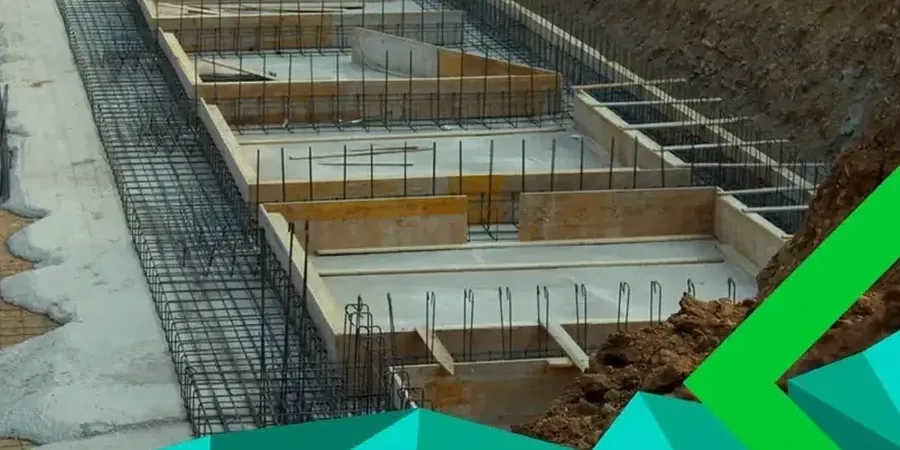
Huntsville sits on the Mississippian-age Tuscumbia Limestone and Fort Payne Chert, with over 40 feet of stiff red residual clay blanketing much of the valley floor. That clay profile holds moisture through the humid Alabama spring and shrinks noticeably during late-summer dry spells, creating a subgrade that can move a pavement slab more than half an inch seasonally. When a plate-load-test confirms modulus values below 4,000 psi at the top of subgrade, the rigid pavement section must be thickened or stabilized, otherwise transverse cracking shows up within the first two winters. We design the joint layout, dowel bar schedule, and base layer to work with the local geology, not against it, so the pavement serves a 30-year design life without requiring early slab replacement at distribution centers, hangars, or bus terminals.

A rigid pavement on Huntsville’s fat clays without a treated base will pump fines through the joints within five years—once we see that in a core, the slab is already losing support.
Our service areas

Process and scope

A tilt-wall distribution center off Greenbrier Parkway sat on six feet of CH fat clay over pinnacled limestone that varied less than 20 feet between borings. The rigid pavement spec originally called for a uniform 7-inch slab, but differential subgrade stiffness would have concentrated load transfer at the joints and led to step faulting near the dock doors. We ran falling-weight deflectometer correlation and rechecked the cbr-road values at 0.2-inch penetration across the pad footprint, then zoned the design into two slab thicknesses with a thickened edge at the rock transitions. Load-transfer efficiency at the contraction joints was specified above 75 percent using 1.25-inch epoxy-coated dowels on 12-inch centers, and the base course was switched to a 4-inch cement-treated permeable layer to intercept perched water moving through the chert rubble zones. The Huntsville Utilities waterline crossing was sleeved through the slab with a compressible filler detail to isolate the pavement from differential settlement at the trench backfill.
Rigid Pavement Design for Huntsville’s Limestone and Expansive Clay Subgrades
Technical reference — Huntsville

Local geotechnical context

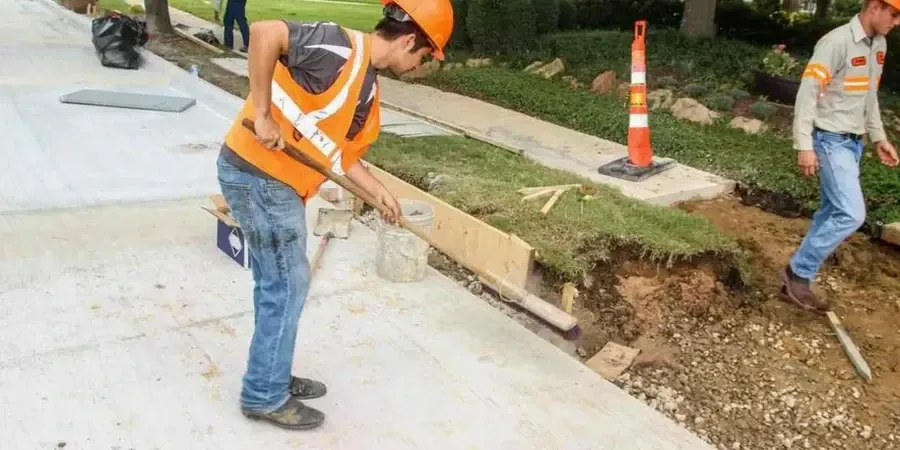
The most common mistake we see on Huntsville rigid pavement jobs is skipping the bond breaker between the slab and a cement-treated base. Without a thin asphalt separator or a polyethylene sheet, the slab grabs the treated layer, restraint cracking develops at random locations, and the joint system designed to control movement becomes irrelevant—you end up with full-depth cracks that mirror the underlying shrinkage pattern. Another recurring problem is specifying dowel baskets on a fine-graded subgrade without staking them firmly; during concrete placement, the baskets tilt, the dowels lock up, and the joints cannot open and close with thermal cycling, leading to spalling and blowups. In the Redstone Arsenal area, where heavy vehicle loads cycle repeatedly, omitting a widened lane or thickened edge at the curb line produces longitudinal cracking that starts at the gutter and propagates into the wheel path within 18 months.

Need a geotechnical assessment?

Reply within 24h.

Email: contact@geotechnical-engineering1.org

Reference standards

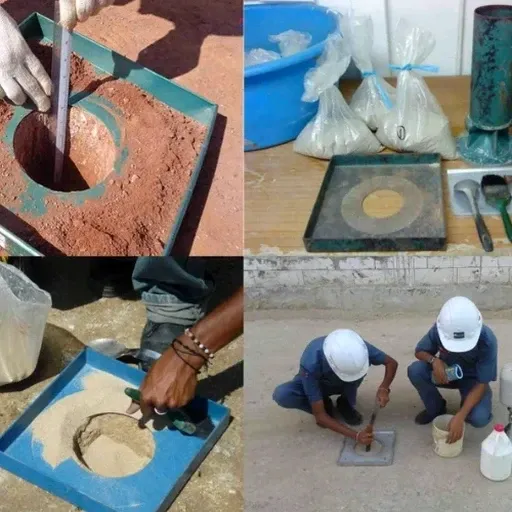
AASHTO Guide for Design of Pavement Structures (1993) with Alabama DOT regional calibration, AASHTOWare Pavement ME Design (MEPDG) for traffic spectra and climate inputs from Huntsville International Airport weather station, ASTM C78 / C78M for flexural strength of concrete (third-point loading), ASTM D1196 for nonrepetitive static plate load test of soil and flexible pavement components, ASTM D1883 for CBR of laboratory-compacted soils, Alabama DOT Standard Specifications Section 450 for Portland cement concrete pavement

Technical data

ParameterTypical value
Design MethodAASHTO 93 / MEPDG (AASHTOWare) calibrated for Region 3
Typical Slab Thickness Range6.5 to 10 inches for industrial and arterial pavements
Concrete Flexural Strength (MR)550 to 650 psi at 28 days (Alabama DOT Class P mix)
Joint Spacing12 to 15 ft for jointed plain concrete pavement (JPCP)
Dowel Bar Specification1.25-inch epoxy-coated round bars, 18-inch length at 12-inch o.c.
Base Course4-inch cement-treated permeable base or 6-inch dense-graded aggregate base (ALDOT 825)
Subgrade StabilizationLime treatment (5-7% by weight) for CH/MH clays with PI > 25
Joint SealantSilicone sealant per ASTM D5893, recessed 1/4 inch below surface

Questions and answers

What does rigid pavement design cost for a Huntsville commercial project?

For a warehouse or retail development in the Huntsville area, a complete rigid pavement design package—including subgrade evaluation, AASHTO 93 and MEPDG analysis, and jointing plan sheets—typically runs between US$2,030 and US$5,510 depending on the number of pavement zones, traffic loading complexity, and whether FWD testing is included in the scope.

When do you recommend rigid pavement over flexible pavement in Huntsville?

We lean toward rigid when the subgrade CBR is below 4, the site has heavy point loads from container handlers or aircraft, fuel spillage is expected, or the owner wants to avoid periodic resurfacing cycles. Concrete distributes load broadly over Huntsville’s variable limestone pinnacle topography, reducing the risk of differential settlement that shows up quickly in asphalt.

How do you handle the karst risk under a rigid pavement slab?

Where borings encounter voids or highly variable rock within 10 feet of subgrade, we first characterize the cavity using cross-hole seismic tomography. If voids exceed 12 inches, we grout them under low pressure, then design the slab with a reinforced section or a double-mat steel cage bridging the feature, paired with a geotextile-wrapped aggregate bridging layer so the pavement can span a future small collapse without catastrophic failure.

Location and service area

We serve projects in Huntsville and surrounding areas.

View larger map