GEOTECHNICAL ENGINEERING
HUNTSVILLE
HomeSlopes & WallsActive/passive anchor design

Active and Passive Anchor Design for Huntsville Excavations and Retaining Structures

Geotechnical engineering with regional judgment.

LEARN MORE

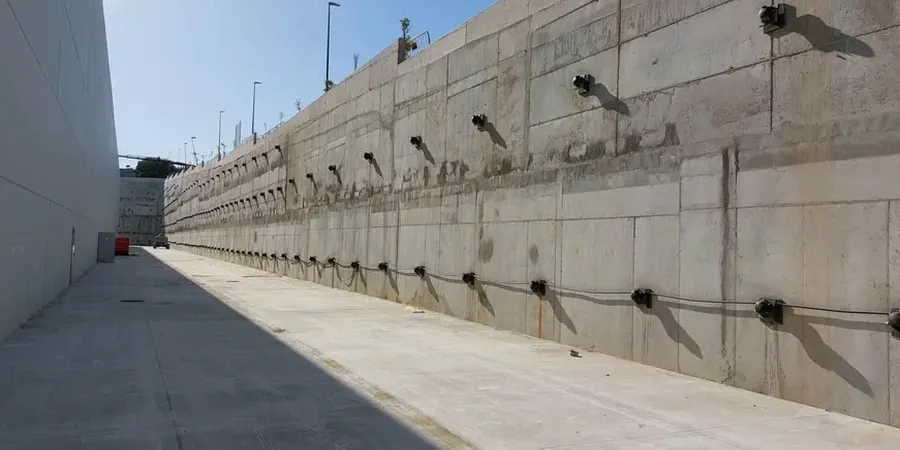
A 40-foot excavation near the limestone bluffs off Monte Sano Boulevard faces more than just soil pressure; it contends with the unpredictable behavior of weathered rock and chert seams that characterize much of north Alabama. Our team approaches anchor design in Huntsville with a forensic understanding of these local formations. We specify both active anchors—tensioned against a structural face to immediately lock in load—and passive anchors, which engage gradually as the ground deforms, a critical distinction when working in the Tuscumbia Limestone and Fort Payne Chert that underly much of the city. Before finalizing a tieback layout, we often integrate subsurface data from SPT drilling to map refusal depths and identify cavities, ensuring every bonded length is placed in competent material, not in a solution void or soft clay seam. For cuts deeper than 25 feet near the Flint River terraces, the design must account for fluctuating groundwater and variable residual soil thickness, making a purely textbook approach insufficient.

In Huntsville’s karst terrain, an anchor’s capacity is only as reliable as the rock it bonds to—our design methodology isolates every bond zone from the influence of solution features.
Our service areas

Process and scope

The 2024 Alabama Building Code, which adopts the IBC 2021 with state-specific amendments, along with ASCE 7-22, governs the load combinations we apply to every anchor design in Madison County. Huntsville’s unique geotechnical profile—residual silts and clays over pinnacled limestone—demands a bonded length analysis that goes beyond standard clay or sand assumptions. We follow PTI DC35.1 recommendations for rock and soil anchors, performing global stability checks that account for the irregular bedrock surface typical of karst terrain. A proper anchor system here must resist not just earth and surcharge loads but also the eccentric forces from wedges of weathered chert that can dislodge during drilling. Our design package includes detailed profiles showing the free-stressing length, the bond zone grout-to-ground friction assumptions, and the tendon encapsulation details against the aggressive, slightly acidic groundwater common in the Highland Rim physiographic province. Complementing the anchor analysis, a slope stability assessment often runs in parallel to verify the global factor of safety for the overall cut face, especially where the excavation intercepts the contact between the soil mantle and the underlying rock.
Active and Passive Anchor Design for Huntsville Excavations and Retaining Structures
Technical reference — Huntsville

Local geotechnical context

When we review excavation plans around Redstone Arsenal or the expanding medical district, the most common oversight is assuming a uniform bond stress in karstic limestone. The reality in Huntsville is that a 15-foot drill hole can pass through sound rock, a clay-filled fissure, and then more rock—a profile that drastically reduces the effective bond zone. Applying a single empirical bond value to such a profile without local correlation data invites progressive anchor failure. Another frequent issue involves corrosion of the tendon assembly. The natural acidity of groundwater in the area, with pH values often dipping below 6.0, accelerates deterioration of unencapsulated steel, turning a permanent anchor into a maintenance liability within a decade. Our risk mitigation approach specifies double-corrosion protection on all permanent tiebacks and requires watertight head details at the face of the wall. We also insist on proof-testing every production anchor to 133% of the design lock-off load, not just a representative sample, to weed out any bond zone compromised by an undetected solution feature or softened clay seam within the limestone.

Need a geotechnical assessment?

Reply within 24h.

Email: contact@geotechnical-engineering1.org

Visual overview

Reference standards

IBC 2021 / Alabama Building Code 2024, ASCE 7-22 Minimum Design Loads, PTI DC35.1 – Recommendations for Prestressed Rock and Soil Anchors, ASTM A416 / A615 – Tendon Material Standards, FHWA-GEC 4 – Ground Anchors and Anchored Systems

Technical data

ParameterTypical value
Anchor Type (Typical for Excavation)Active (prestressed) and Passive (reactionary) strand or bar tendons
Tendon Material SpecificationASTM A416 Grade 270 low-relaxation strand; ASTM A615 Grade 75 or 150 ksi threaded bar
Bond Length in Limestone10 ft to 25 ft, determined by rock mass rating and grout-to-rock adhesion
Corrosion Protection LevelClass I (encapsulated) for permanent anchors; Class II for temporary in aggressive water
Testing ProtocolPerformance test per PTI DC35.1; lift-off and extended creep tests on production anchors
Design Working Load Range30 kips to 200 kips per anchor, verified by limit equilibrium analysis

Questions and answers

What is the typical budget range for designing an anchored excavation support system in Huntsville?

The engineering design fee for an anchored system typically ranges from US$1,110 to US$4,160, which includes the anchor layout, bonded length calculations, corrosion protection specifications, and stamped construction drawings. The final figure depends on the height of the cut, the number of anchor rows, and the complexity of the subsurface profile. A 20-foot excavation in uniform residual soil will fall on the lower end, while a multi-tiered anchor system for a 40-foot cut in pinnacled limestone will be at the higher end due to the additional analysis and testing specifications required.

How do you decide between active and passive anchors for a Huntsville site?

The decision hinges on the allowable movement of the retaining structure. Active anchors are prestressed to lock in the design load immediately, making them the right choice for soldier pile walls in the medical district where adjacent foundations cannot tolerate any lateral movement. Passive anchors engage only as the wall deforms, which can be acceptable for temporary cuts in greenfield sites north of the city where some deflection is tolerable. We also consider the rock quality; in highly fractured Fort Payne Chert, a passive rock dowel may be more reliable than a tensioned anchor that could lose load if the rock mass relaxes.

What level of corrosion protection is required for permanent anchors in north Alabama?

Given the acidic groundwater conditions common in Madison County’s limestone aquifers, we specify Class I (encapsulated) corrosion protection for all permanent anchors. This means a corrugated plastic sheath over the entire tendon, filled with cement grout, plus a smooth plastic jacket over the free-stressing length. The anchorage head is sealed with a permanent cap and injected with grease. For temporary anchors in dry conditions, a Class II protection with just the grout column may suffice, but we typically recommend an upgrade to encapsulated protection whenever the service life exceeds 18 months due to the aggressive local water chemistry.

Location and service area

We serve projects in Huntsville and surrounding areas.

View larger map