GEOTECHNICAL ENGINEERING
HUNTSVILLE
HomeIn-Situ TestingField permeability test (Lefranc/Lugeon)

Field Permeability Testing in Huntsville’s Karst Limestone — Lefranc and Lugeon Methods

Geotechnical engineering with regional judgment.

LEARN MORE

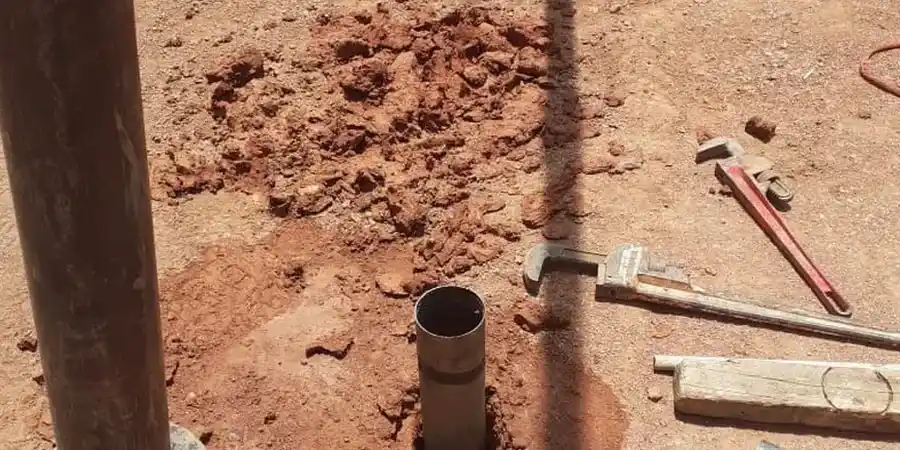
The wireline winch hums and the double packer descends into a NQ borehole drilled into the Bangor Limestone. This is the Lugeon test setup running on a site near the Tennessee River, where fractured rock dictates everything about seepage and grouting. Huntsville’s geology is not subtle — the karstic Mississippian limestone beneath much of the city can swallow a drill string in a cavity or deliver Lugeon values that jump from 2 to 45 Lu across a single five-foot interval. Our field team runs both the constant-head Lefranc method in soil overburden and the multi-stage Lugeon test in bedrock, following IBC Chapter 18 and the USBR Earth Manual. When the question is not just “how permeable” but “where exactly,” we pair the test with a seismic refraction survey to map the top of rock before the packer goes down. In a city mapped across four major karst watersheds — including the Flint River losing stream — guessing at permeability is a budget risk no geotechnical engineer needs to take.

In Huntsville’s karst, a Lugeon value without a pressure-stage curve is like a rainfall total without duration — it tells you something, but not what the rock will actually do.
Our service areas

Process and scope

The contrast between a site in downtown Huntsville and one out in the Limestone County agricultural belt is a permeability story in one county. Downtown, near Big Spring, the residual red clay overlies cavernous Monteagle Limestone; the Lefranc test in the clay gives a steady 1×10⁻⁶ cm/s, perfectly acceptable for a stormwater detention basin until the borehole punches a void at 28 feet and circulation drops to zero. Ten miles west, a subdivision site on the Fort Payne Chert shows dense, tight bedrock — Lugeon values of 3 Lu in the upper 40 feet — good rock for a shallow mat foundation, but the chert fractures are oriented northeast and open at depth, requiring a grouting curtain if the basement excavation goes deeper. Three factors shape every test: the seasonal groundwater table (which fluctuates 15 feet between winter and summer in Madison County), the weathering profile thickness (5 to 80 feet depending on whether you are on a ridge or in a paleovalley), and the presence of solution-enlarged bedding planes that make single-packer tests unreliable. We run at least three pressure stages per test interval — 25, 50, and 75 psi — to detect dilatancy or infilling of fractures, and we log flow rate every minute with a calibrated flowmeter because a steady reading at minute five does not guarantee a steady reading at minute ten in karst.
Field Permeability Testing in Huntsville’s Karst Limestone — Lefranc and Lugeon Methods
Technical reference — Huntsville

Local geotechnical context

The 1960s expansion of Huntsville’s arsenal and aerospace campuses drove rapid development over terrain whose subsurface was mapped at 1:250,000 scale — essentially useless for foundation design. Dozens of older structures in Research Park sit on footings designed with permeability assumptions from weathered shale, when in fact the underlying Tuscumbia Limestone carries open conduits that convey stormwater into the Madison aquifer. A field permeability test run too short, or without packer isolation, will miss the horizontal fracture that connects a building excavation to a sinkhole half a mile away. The biggest liability we see today is infiltration BMPs sized from textbook infiltration rates — a 0.5 in/hr design value applied to a site where the actual field-tested rate is 0.08 in/hr creates a detention basin that never drains, breeding mosquitos and failing inspection. The IBC 2021 edition requires site-specific permeability data when designing deep foundations in karst; we run the Lugeon test in at least three boreholes per foundation zone, and if the mean Lugeon exceeds 15 Lu, the recommendation goes straight to compaction grouting or a liner system.

Need a geotechnical assessment?

Reply within 24h.

Email: contact@geotechnical-engineering1.org

Visual overview

Reference standards

IBC 2021 Chapter 18 — Soils and Foundations, ASCE 7-22 — Minimum Design Loads and Groundwater Provisions, USBR Earth Manual — Lugeon Test Procedure (Houlsby Method), USACE EM 1110-2-1901 — Seepage Analysis and Control

Technical data

ParameterTypical value
Test methodLefranc (constant-head in soil), Lugeon (multi-stage in rock)
Borehole diameterNQ (76 mm) for Lugeon; 4-inch hollow stem auger for Lefranc
Packer typePneumatic double packer, 1.5 to 3.0 m test interval
Pressure stagesThree-stage (low-mid-high), per USBR and Houlsby method
Measurement frequencyFlow rate logged every 60 seconds, pressure transducer backup
Reporting standardIBC Chapter 18, ASCE 7-22 groundwater provisions

Questions and answers

What is the difference between a Lefranc test and a Lugeon test, and when do I need each in Huntsville?

The Lefranc test measures permeability in soil — typically residual clays and weathered rock — using a constant water head in an open borehole section. It is the go-to method for infiltration basin design and septic field sizing. The Lugeon test is a packer-isolated test in competent rock that measures the water take of a discrete interval under multiple pressure stages. In Huntsville, we need the Lugeon whenever the foundation bears on limestone or when a dam, deep excavation, or cutoff wall intersects bedrock. A site with 20 feet of red clay over limestone may require both: Lefranc in the clay for the stormwater plan, Lugeon in the rock for the foundation drain design.

How much does a field permeability test cost in the Huntsville area?

A complete field permeability testing program — including mobilizing the drill rig, setting packers, running multi-stage Lefranc and Lugeon tests, and delivering the geotechnical report — generally runs between US$670 and US$1,070 per test interval. Mobilization and traffic control for busy corridors like Memorial Parkway or University Drive may add to the base cost. A typical investigation with three test intervals and a summary letter falls near the midpoint of that range.

How long does a Lugeon test take on a typical Huntsville site?

A single five-foot Lugeon test interval, run with three pressure stages and steady-state flow verification at each stage, takes roughly 45 to 60 minutes of active testing. Add drill setup, packer inflation, and water tank refills, and a three-interval test program in a 100-foot borehole can be completed in one field day. Report delivery — including Lugeon unit calculations, pressure-flow plots, and geotechnical interpretation — typically follows within three to five business days.

Location and service area

We serve projects in Huntsville and surrounding areas.

View larger map